
How to Stop Overthinking
Part 1: 6 Practical & Unique Exercises for Overcoming Overthinking

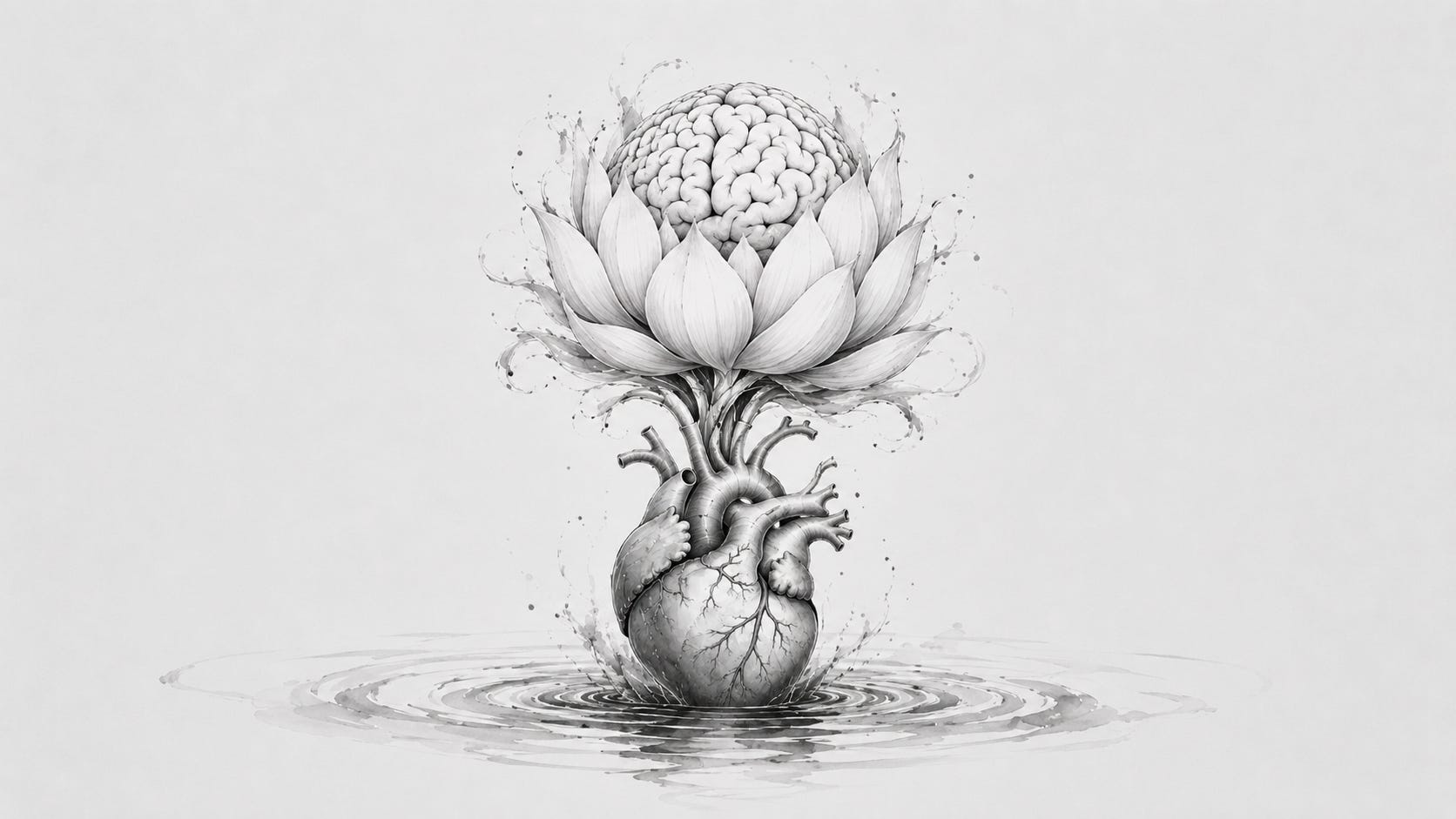
My anxiety accompanied me like a shadow, but when I got to know it through awareness we became very good friends.”
Mingyur Rinpoche
Healing The Overthinking Pandemic
We currently live in an Overthinking Pandemic. A recent widespread survey found that anywhere between 54% - 75% of people consider themselves to have a problem with overthinking..
When people present ways for people to stop overthinking, they often offer grand theories of overthinking; all manner of models and systems and maps. Often, all this does is give people more things to overthink about. There’s nothing the overthinking mind loves more than more models, systems and maps to get lost in.
Instead, in this article, I’d like to cut to the chase and offer practical tools that you can sit down and do every day (and often do without sitting down). Tools that will allow you to get out of thinking mode and into doing mode. But also, perhaps even more importantly, to help you get into being mode; a mode that both thinkers and doers have largely lost touch with in modern society.
This is a 2 part article. In today’s Part 1, I will be discussing techniques that you can do alone, that largely centre around connecting more deeply to your body, your sensations and your emotions. Part 2 (to come out at a later date) will focus more on techniques based in connecting to things outside our bodies, including nature, community, singing, dancing, acting, exercise and medicines.
So, here are some initial practices you can try.
Practice 1: Connecting to the Intelligence of Your Body
There can be a tendency to think that all our intelligence is contained in our heads. This can cause people to retreat into their heads when they want to solve a problem. If you think your head is where intelligence lives, of course you are going to get trapped there whenever you are trying to navigate a problem
But actually, much of our problem-solving capability is distributed through our body.
For overthinkers, a particularly useful part of our bodily intelligence to get acquainted with is the intelligence in our hands. There’s a fascinating neurolinguistic theory that the human capacity for language developed initially by leveraging the neurons used for grasping things with our hands. This is reflected in the language we use to describe thought. We “grasp a concept,” “get a handle” on the truth, and “hold” beliefs. We “touch on” ideas, “seize upon” a point, and “point out” facts. All this speaks to how much our verbal thinking mind borrows from the grammar of how our hands move.
The fact that our linguistic thinking mind and the intelligence in our hands are such close cousins, means that our hands can be one of the most effective routes out of overthinking when caught in thinking loops. Next time you are overthinking, one thing you can do is shift your awareness from your head to your hands. The hands then provide a natural bridge out of thinking mode and into doing mode. This is because unlike thoughts, our hands are naturally geared towards manipulating the world. Additionally, hands - especially the fingertips - have some of the highest density of sensory nerves in our entire body. By placing our awareness on our hands, therefore, we are not just moving into doing mode, but also into sensing mode.
Another practical exercise in a similar vein is to bring your awareness to your feet. Our feet are geared for locomotion, so putting our consciousness there primes us for movement. They also connect us to the earth and what is “outside ourselves”. Finally, feet are the body parts furthest from our heads, so activating them brings blood flow away from our brains.
Actually, what we’ll find is that each of our body parts has a specific intelligence that can be drawn upon for different purposes. If you are digesting a difficult emotion or event, you can bring awareness to your gut and put trust in it to digest the problem for you. If you want to connect more to other people, instead of cooking up plans in your head, you can connect to the warmth in your heart and see where it leads you.
In general, I believe we become much more effective operators in the world when we perceive our whole nervous system as the seat of our intelligence, rather than just our brains. We also become less trapped in our heads. .And our entire nervous system is basically a map of intelligent pathways out of the head and into contact with the world.
Practical Technique: Next time you are caught in a thought loop, bring your awareness to your hands. Don’t approach them as just lumps of flesh but as loci of intelligence within your nervous system. Try to feel into what your hands want to do - what do they want to touch, where do they want to go, what actions do they want to take and how do they want to manipulate the world. Try also doing the same exercise with other parts - bring awareness to your feet and see where they want to take you. Bring awareness to your heart and see who it wants to connect to. Bring awareness to your gut and let it just silently digest your emotions for a while.
Practice 2: Discovering the Bodily Tensions that Underlie Mental Tensions
You may notice that you are more likely to overthink when you are stressed. There is a tenseness to the mental state of overthinking. Often what we will find is that this mental tension has roots in tensions within our bodies.
When it comes to overthinkers, I often observe that they seem to hold a lot of tension in their abdomen. This makes sense as there is a lot of connectivity between the brain and the gut and lots of neurons in the gut. So, it’s easy to see how tensions in the gut may get reflected in the brain. Our brains originally evolved to operate our bodies and much of our more complex cognitive infrastructure was built on top of that. So it’s often more intuitive for our minds to tackle tensions at the level of the body than at the level of the mind. When overthinking, it can be a lot easier to try releasing accumulated abdominal tension than trying to actively stop the thinking itself.
Practical Technique: When overthinking, try going for a relaxed stroll and place your awareness on your abdomen for the entirety of the walk. Try to notice if there are any tensions there and every time you feel a tension release it. Then, try to notice if this causes your mind to quiet down. In many cases, people will find that when their abdomen is still and untensed, their mind will become still and untensed. For others, these tensions may be elsewhere in the body (hips and chest are other common targets). Finding correlates in the body can be especially useful as voluntarily releasing a bodily tension can be a lot easier than trying to release a compulsive pattern of thought.
Practice 3: Learning To Feel Your Thoughts
The following technique is a particularly powerful one as it allows you to actually transform the energy of overthinking into being its own cure.
We often think of thoughts and feelings as diametrically opposed things. Thinking, we might believe, is the opposite of feeling. But actually, when we look very closely at our thoughts we see that they have a sensory component to them.
If you really tune in deeply to the space within your head when you are thinking, you may feel a kind of tingling sense that some experience a sort of magnetic field or barely perceptible electric current. This is the flow of subtle energy that forms into verbal concepts when you think.
This energy actually flows all throughout our body, but is particularly easy to sense in the head - especially for overthinkers - because so much of the nervous system is concentrated in the head. The more you gain sensitivity to the pre-verbal sensory-energetic field in your brain, the easier it is to start sensing it elsewhere. Once you’ve located the sensation in your head, you can actually follow that pre-verbal sensory-energetic field out of your head and into your body. You will hopefully start to see that this same energy that feels so compelling inside your head - that energy that leads you to compulsively think and think - flows through every part of your nervous system. And it is just as fascinating to tune into as any thought. Indeed tuning into the unique manifestation of this energy in different parts of your nervous system will give you access to all manner of new sensations, skills, intuitions, and ways of knowing and feeling. Entire new rooms to explore in the mansion of your being.
Not only will learning this technique help you break out of compulsive thinking loops, but it can help you see how your overthinking is secretly training a certain type of sensitivity in you. A sensitivity that can be used to unlock deep wisdom, hidden loci of awareness, and mysterious expansions of your consciousness that go far beyond the confines of words.
Practical Technique: Sit down quietly and focus on your breath until your mind becomes calm. Once you feel relatively calm, move your awareness away from your breath and onto the space inside your head. Allow thought itself to become the object of your meditation in place of the breath. Every time your attention moves elsewhere, notice it and bring awareness back to the space inside your head. Instead of paying attention to the conceptual content of your thoughts, instead pay attention to how they feel inside your head. See if you can start to notice something that feels like a magnetic field or light electric current or perhaps the pre-verbal ghost of a thought about to form. Allow a good amount of time to simply be with this sensation. Then notice the way that this sensation has a natural sense of movement to it. Let it move where it wants to go, including outside of your head. Follow this magnetic / electric sense outside of your head and into your body. Notice how there is no distinct boundary between the thinking-field you’d been focusing on before and the overall magnetic-electric-like field of sensation that penetrates your whole body. Allow this current of feeling to lead you out of your head and back into contact with your body.
Practice 4: See into the Emptiness of Thought
Once we have solid contact with the felt sense of our thoughts, we can start to liberate ourselves from their compulsive power over us by looking deeply into their nature and how they are constructed.
When we are able to hold our mind very still and look at the sensation of thought described in the practice above, we will see that it is not the kind of substantial, continuous, solid thing that can hold power over us. Rather, thoughts reveal themselves to be insubstantial, discontinuous and spacious. When we zoom in, we see that there is always little gaps of time between thoughts. We also see that there are spatial gaps between the microsensations that make up thoughts; more space actually than sensation. We see that they change shape and quality depending on how we look at them.
When we start to see how insubstantial thoughts are - really see it on a felt level - they start to lose their compulsive power over us. It then becomes much easier to consciously choose whether and how we want to be thinking at any given time.
Practical Exercise: As in the previous exercise, calm yourself with breath awareness then shift your awareness to the sensation of thinking in your head. This time, pay special attention to noticing the insubstantial, discontinuous and spacious nature of the thought-sensations. In particular you want to pay attention to the vibratory, fluctuating, dissolute aspects of the energy that allow you to see gaps in its solidity and show you the way in which that fixed / definite nature of the energy is constructed and illusory. Notice then how when the energy is seen as insubstantial, spacious and dissolute - and crucially, without a fixed, continuous nature - it starts to lose its compulsive power.
Practice 5: Coming into Loving Relationship with Painful Emotions
The brain is one of the few major human organs that has no pain receptors. I think this provides some interesting clues as to what drives overthinking and causes people to live in their heads. In most cases, I believe overthinking stems from some emotional or physical pain we are trying to avoid.
It makes sense therefore that someone trying to avoid pain would retreat into their brain. Its lack of pain receptors makes it a seeming safe haven against having to feel difficult emotions and sensations. Living in the head is the optimal place to numb out.
The problem of course is that doing this doesn’t get rid of the pain, but rather just keeps it out of awareness. But actually the best way to process, transform and release pain is by bringing it into awareness It is the light of awareness that allows painful emotions to see where they are going and resolve themselves.
This is part of how overthinking creates a negative feedback loop:
Overthinking > numb out pain > pain festers and grows > more incentive to overthink to numb out pain
Probably the most direct way to break this feedback loop is to develop a gentle openness to experiencing our emotional pain. Inviting it back into our awareness.
The key to inviting difficult emotions and painful experiences back into awareness, is to learn how to hold our difficult emotions in love. When we have an aversive relationship with feeling pain or difficult emotions, it is natural to resist them from coming into awareness. This is when we will recruit overthinking to cover them up. By mastering the skill of giving love to our difficult emotions and painful sensations, we can drop our resistance to them and allow them back into awareness. With the need to block them out of awareness now gone, the overthinking function is made redundant and dissipates.
Practical Exercise: The best beginners exercise I know for cultivating an attitude of love towards our difficult emotions and painful sensations is an adaptation of Buddhist loving kindness practice. But in this version, instead of sending loving kindness to other people, we send it to our own internal emotions/sensations. You can start by sitting alone in a quiet place with your eyes closed. Try to invite any difficult emotions or painful sensations into your awareness, offering them an internal attitude of welcoming invitation. When you feel a difficult emotion or painful sensation send it love. For some people, it works best to internally say something like “I love you, you are safe, you are welcome” to the emotion / sensation when it arises. For me, I find a non-verbal approach best. I simply try to connect to the natural warmth in my heart and feel myself spreading it to the difficult emotion or painful sensation, so that it becomes entirely bathed in the warmth of my love.
Practice 6: Try Relaxing Your Brain!
We shall end with an utterly irrational exercise. There is nothing the thinking mind hates more than irrationality - so it can be a great medicine for disrupting the machinery of overthinking.
In this exercise, we simply … relax our brain!
Although the brain is not a muscle, it’s filled with blood vessels that can become contracted. This contraction involves tension in the smooth muscles around them. And although the brain itself has no pain receptors and little sensory architecture in general, at the level of experience, there is a sense in which we can still feel it. If we tune into our brain as a brute, fleshy physical organ (a slightly different mental motion to tuning into the electric-magnetic-like current of thoughtdescribed above), subtle sensations can start to be felt there.
This could be vascular constriction. Or, perhaps more likely, its inferred impact on scalp arteries / pericranial muscles & fascia. But we don’t need to worry about all that - we can let our rational defences down for a moment and allow ourselves to have the internal experience of feeling our brain.
So, once we feel it, how might we relax our brain?
Simply bring awareness to where your brain is and try to relax it as if you are relaxing a muscle. Don’t think about how to do it. Don’t think about the fact the brain is not in fact a muscle. Don’t think at all, actually. Just bring awareness to your brain and enact the mental/physical motion of relaxing it like opening a palm. Even if you don’t feel any sensations there - you still do the same mental/physical motion of relaxing it. Just see how your body responds to the instruction to “relax your brain.”
Practical Exercise: Just relax your brain! Don’t overthink it! Do it!
Part 2 Coming Soon!
This article is part of a planned 2 part series on overcoming overthinking. Part 1 focused primarily on internal techniques you can use whilst alone, especially ones based in connecting more deeply to our bodies and internal sensory landscape. Part 2 will focus more on techniques based in connecting to things outside our bodies, including nature, community, singing, dancing, acting, exercise and medicines.
So if you are interested in discovering the other half of the equation when it comes to overcoming overthinking, please subscribe (for free!) below.
What we find is that a lot of emotional pain, when full experienced in awareness, slowly starts to transform.
Intimately, when we get very skillful at sensing into emotions, all emotions - including the painful ones - reveal themselves to be fundamentally neutral energies.
It is largely our pushing away of the emotion that makes it feel painful.
So gently accepting it back into awareness helps it transform back into neutral energy.
This not only heals the emotional pain and breaks the overthinking cycle, but it also makes this now neutral energy available to power effective action.
When I first started practicing meditation, I kept waiting for something super profound to happen. Like a life-transforming experience with the divine or some magical insight. It took me years to calm that expectation down. After a few years of practice, I was with a friend who said something that would normally trigger me and send me into that overthinking mode you dissect here. But at that particular moment there was this slight pause--a gap between my thought and my next action. And I had a realization that that gap was meditation doing its thing.
I love your steps listed here because they don't require years of practice. I especially liked the idea of our hands (and the rest of our body) having a sort of intelligence. And how the everyday phrases we use--grasp a concept, get a handle on things, etc... signal that at some point we made this connection between body and mind. I also liked how you pushed this all beyond simply self-healing to using the reclaimed power to "power effective action."
Great Article! Can't wait for part 2. I think having an outlet for our attention besides our thought is wonderful gift. So many people don't even notice the haze of thoughts buzzing in their heads incessantly.